A Career in Audio Visual: Roles, Skills and Career Opportunities


It’s 8.55am and a conference hall is filling up, with two thousand people in their seats and thousands more watching online. When the screens come on and the mic works first time, nobody notices. That’s the point.
Behind that moment is a team of audio visual (AV) professionals, each with a different job. To see where you might fit, let’s rewind this conference back to the very first phone call.
What does a career in audio visual involve?
AV professionals design and run the sound and video systems used at live events and in workplaces. Some roles are hands-on while others are more client-facing, and most people move between a few of them over their career.
Months before: the technical sales consultant
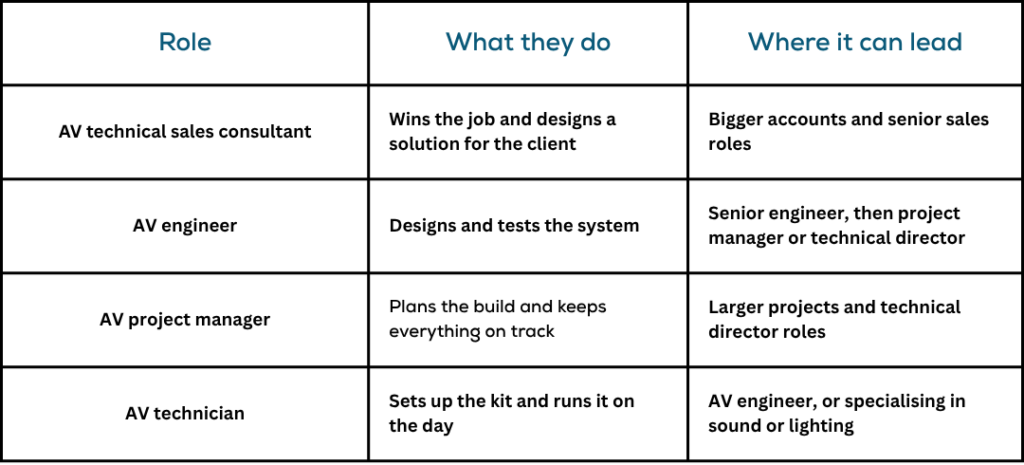
The client wants a hybrid conference that works as well for people at home as it does in the room. The technical sales consultant works out what that means in kit and cost and turns it into a proposal. It suits people who know their tech but also enjoy talking to clients, and employers usually want at least six months of AV experience first. Our technical sales consultant guide goes into more detail.
Weeks before: the AV engineer
With the job won, the engineer designs the system. How many speakers will the hall need? Where should the cameras go so the livestream doesn’t look flat? It’s a role for problem solvers, and because more AV now runs over IT networks, networking knowledge counts for a lot. Free training like Audinate’s Dante Certification is a good place to start.
The week of: the AV project manager
With a week to go, the project manager takes over. They make sure the right crew and kit turn up at the right time and keep the client in the loop when plans change (they always do). Many come up through technical roles, so they understand what the crew needs on the ground.
The day itself: the AV technicians
The day before the conference, the technicians arrive at the venue to rig the speakers and screens. By 8.55am on Monday, it’s all in place, and nobody in the hall has any idea how much went into it. The technicians run sound and video throughout the day, and when the last delegate leaves, they take it all down again. The National Careers Service lists staying calm under pressure as a key skill, which makes sense when a mic cuts out halfway through a speech. Lots of technicians start out freelancing on live events, and our guide to freelance jobs in audio visual explains how.
The roles at a glance
What skills do you need for a career in audio visual?
Every role above needs a mix of these, just in different amounts:
- IT networking, as more AV systems now run over standard networks
- Problem solving, because no two events are ever the same
- Communication, with clients and with the rest of the crew
- Staying calm when there’s a live audience watching
Our guide to the AV technician skills employers look for in 2026 goes into more depth.
What career opportunities are there in audio visual?
AV has clear routes up, and plenty of ways in:
- You don’t need a degree. The Level 5 Audiovisual Technician apprenticeship takes around two years, and you can search for places on GOV.UK’s Find an apprenticeship service.
- Moving up. Our AV engineer guide shows a common path from junior engineer up to project manager or technical director.
- Freelance or permanent. There’s work in both across live events and systems integration, depending on whether you prefer variety or stability.
Find your place in AV
We’ve been placing AV professionals since 2000, and we were the first UK agency to focus on this sector. If you’re looking for your first role or your next step, our team can help you work out where you fit and tailor your CV to get there.
Have a look at our latest AV jobs, or register your CV and we’ll be in touch.

Latest Blog
No results found.....