How to Become an AV Technician in the UK


Nobody walks into their first AV job and runs a boardroom on day one. Most technicians start out carrying cases and coiling cables, while watching someone more experienced fix a problem they didn’t even notice.
That slow start is completely normal, and it’s how the best technicians learn. So instead of another checklist, this guide shows you what becoming an AV technician actually looks like, from landing your first role to the end of your first year.

How do you become an AV technician in the UK?
Most people become AV technicians by starting in an entry-level role, like an assistant or trainee technician, and learning on the job. You don’t need a degree. The most common ways in are college courses and apprenticeships, and volunteering with a theatre or community group is a great way to build up experience along the way.
Before you start: landing your first role
There’s more than one way in, so pick the one that suits where you are right now:
- Courses in digital media or creative media production are a good place to start, and there’s now a T Level in Media, Broadcast and Production too.
- You earn while you learn, with options at advanced (Level 3) and higher (Level 5) level. You can search for places near you on GOV.UK’s Find an apprenticeship service.
- Helping out at a local theatre or on a church sound desk counts as real experience, and it’s well worth putting on your CV.
- Freelance crew work. Lots of people get their foot in the door helping out at live events. Our guide to freelance jobs in audio visual explains how to get started.
Starting salaries for AV technicians are around £22,000, rising to about £35,000 once you’re experienced. The first year is an investment, and it pays off.
Your first year as an AV technician
Everyone’s first year looks a bit different, depending on whether you’re doing installs, working in a venue or out at events. But this is roughly how it tends to go.
Months 1 to 3: watching, carrying and asking questions
Your first few months are all about learning how things are done. You’ll spend a lot of time helping set up and pack away kit, and shadowing more experienced technicians on the job. It might not feel glamorous, but this is where you pick up the habits that make a good technician, like labelling cables properly and testing everything twice.
Ask questions. Lots of them. Nobody expects you to know it all yet.
Months 4 to 6: your first installs
By now you’ll be trusted with more of the hands-on work, like running cables and mounting screens, with someone still checking over your shoulder.
If your role involves installs, you’ll probably need a CSCS card, as many construction sites won’t let you on without one. To get one, you’ll need to pass the CITB Health, Safety and Environment test. Apprentice cards are free, so it’s worth checking if you’re on an apprenticeship.
Months 7 to 9: fixing problems on your own
This is when it starts to click. Instead of calling someone over every time something goes wrong, you’ll start working out faults yourself. Six months is also the experience AVIXA recommends before taking its CTS exam, one of the best known certifications in AV, so it’s a good time to start working towards it.
Months 10 to 12: running things yourself
By the end of your first year, you could be setting up a meeting room on your own or running sound at a smaller event. You might even find yourself showing the next new starter the ropes, which is usually when you realise how far you’ve come.
Does starting with a degree or qualifications make a difference?
Yes, but probably less than you’d think. A degree isn’t required, and everyone still needs that time on the job. What qualifications can change is where you start, and how quickly you move through the early stages.
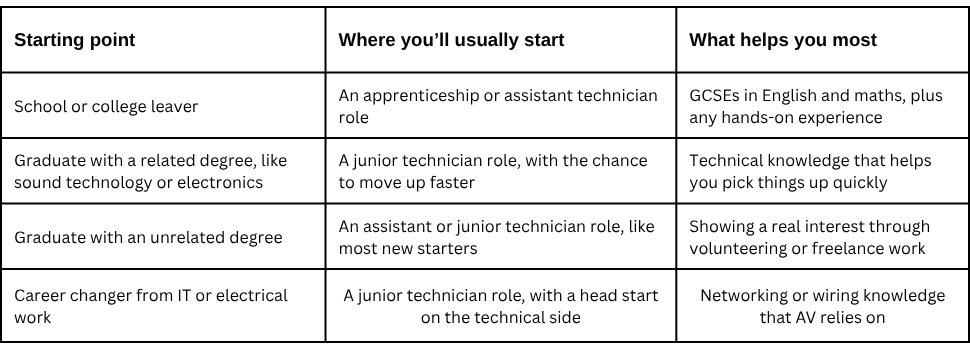
If you have A levels, you could also go straight for a higher apprenticeship, like the Level 5 Audiovisual Technician apprenticeship. Whatever your background, though, there’s no shortcut for time spent on the job. A graduate and a school leaver will both spend their first few months learning the kit.
What comes after your first year?
After a year or two, most technicians either start to specialise, for example in sound or lighting, or work towards becoming an AV engineer.
Ready for month one?
Often the hardest part of the whole journey comes before month one, when you’re trying to get someone to give you that first chance. That’s the bit we can help with. Tell us where you’re starting from, whether that’s straight out of education or from a completely different job, and we’ll help you find a first role that fits.
Browse the AV roles we’re recruiting for right now
Latest Blog
No results found.....